
How The Work Actually Works
You have seen what the work does. This is what is running underneath it.
Pressure
These frameworks weren't designed in a consulting room. They were built and tested in extreme environments across 25 years of high-stakes operations.
for This
Sport Psychology honours degree. International-level athlete. A deep understanding of how people actually think, decide, and perform when it counts.
Extremes
From Arctic expeditions to boardrooms to safari lodges across Africa. The RAPG system has been tested everywhere conditions were real and consequences were real.
Just What Works.
You will not leave with more information. You will leave with a system. One that holds up under the kind of pressure you actually face.
Everyone wants to perform better at life.
You already know how to train your body. Pick the weak thing, work it, measure it, go again. Nobody calls that soft. This is the same, aimed at everything else. Your work, your head, your relationships, the version of you that shows up when it counts.
Executives. Athletes. Guides. Coaches. Parents. It does not matter what you do or what you are trying to build. What limits most people is not knowledge or effort. It is whether their core human needs are being met.
When those needs go unmet, the system degrades. Decisions slow down. Pressure hits harder. People fall back on the same patterns. That gap shows up before anything else does.
Everything I do, whether it is one-on-one coaching, a keynote, or a multi-day immersion, is built on this.
Everything a person does is an attempt to meet one of six needs. This is not my idea. It goes back to Maslow, and it was sharpened by others after him. But I have watched it hold true in boardrooms, on safari, and on the ice, and it is the closest thing I have found to a map of why people do what they do.
Here is the part most people miss. You are not trying to meet all six at once. At any point in your life you are really running on two. Those two are driving your decisions, your habits, and the patterns you cannot seem to break. They shift over time. The work is knowing which two are running you right now, because once you see them, a lot of what felt like a willpower problem turns out to be a need going unmet.
Everyone needs some ground that does not move. Predictability. Enough control to feel safe. When you have it, you stop bracing and you can actually think. When you do not, everything narrows. You over-plan, you grip too tight, or you freeze. The people who perform well are not the ones with the most certainty. They are the ones who build a few solid things they can count on, routines, a system, money in the bank, so the rest of their attention is free for the hard stuff. Too much of it, though, and you go stale. Certainty taken too far is just another word for stuck.
The opposite pull. You also need the unknown. Novelty, challenge, something that is not decided yet. Without it life goes grey and flat and you start doing stupid things just to feel awake. This is the one that trips people up, because it sits right against certainty. You want the ground to hold still and you want to be surprised. Both at once. The person who only feeds certainty gets bored and stuck. The person who only feeds uncertainty burns through jobs, relationships, and plans chasing the next hit. Performance lives in holding the two in tension, not picking one.
The need to matter. To be seen, to count for something. This one drives more behaviour than people admit. Handled well, it becomes mastery and leadership. You get significant by being good and by helping. Handled badly, it turns into ego, comparison, or making yourself the problem so someone pays attention. A lot of what looks like self-sabotage is just someone getting their need to matter met in the only way they know how.
The need to be close to something. People, a team, a partner, a dog, a mountain, God, whatever it is for you. Nobody performs alone for long. Connection is what carries you through the days you cannot carry yourself. Handled well it is love and belonging and a team that makes you better. Handled badly it is people-pleasing, staying somewhere toxic because leaving feels worse, or keeping everything shallow so nothing can hurt you. A lot of talented people quietly starve here while the rest of their life looks fine.
If you are not growing you are dying. That is true of a body, a business, a marriage, a person. Growth is the need to become more than you were. Learn something. Get stronger. Understand something you did not before. It is the one that turns a plateau into a next chapter. The people who last are the ones who keep feeding it. The trap is growth with no direction, motion for its own sake, or using constant improvement as a way to never sit still and never be enough as you are.
The need to give something beyond yourself. Help someone. Build something. Leave the place better than you found it. This is the one that pulls performance out of ego and into purpose. It is also the one that keeps the top from feeling empty, because plenty of people get everything they wanted and still feel hollow, and it is almost always this that was missing. The shadow side is giving until there is nothing left, or giving loudly so everyone sees you do it.
The first four keep you functioning. The last two are where fulfilment actually lives. Most people meet the first four and wonder why it still feels empty. The answer is usually growth and contribution, sitting untouched.
The work is not learning the six. It is being honest about which two are running you, whether the way you meet them is building you or quietly wrecking you, and what changes when you start meeting them on purpose instead of by accident.
The six needs explain why you do what you do. RAPG is what keeps you steady while you do it. Four things. Resilience, Agency, Positivity, Gratitude. When the pressure comes, and it always comes, these are what hold.
The one people misunderstand most. Resilience is not what happens after the hard thing is over. It is bouncing back while the stressor is still there. Still on the ice. Still in the crisis. Still carrying the weight, and finding your feet anyway. Recovering after it ends is just healing. Resilience is holding your shape in the middle of it.
The belief that what you do matters. That you are not a passenger. Most people, when things get hard, quietly hand the wheel to circumstance. The economy, their boss, their past, their luck. Agency is taking it back. It does not mean you control everything. You control almost nothing. But you control your effort, your preparation, and what you do next, and that is enough.
Not the fake kind. Not pretending the day was good when it was brutal. Real positivity is a trained bias toward what is still possible. You look at the wreck of a plan and instead of only seeing what broke, you find the one thing you can use. It is a skill, not a mood. It is the difference between this ends me and this is just the next problem.
The one that holds the rest steady. Gratitude pulls your attention off what is missing and onto what is actually there. The progress. The people. The fact that you get to do this at all. It sounds soft. It is not. On the ice, on the worst days, it was often the only thing that reset my head. It fights the entitlement and the burnout that quietly kill people who have everything and still feel empty.
Here is the part that matters. These four are not separate. They are a chain, and it builds from the bottom.
If you cannot find something to be grateful for, it is very hard to be positive. If you are not positive, it is very hard to believe your actions matter, so agency slips. And without agency, resilience has nothing to stand on. Gratitude holds up positivity. Positivity holds up agency. Agency holds up resilience. Knock out the bottom and the whole thing comes down. When it breaks, you rebuild from the ground up.
Build it from the bottom. Lose the base and the top falls.
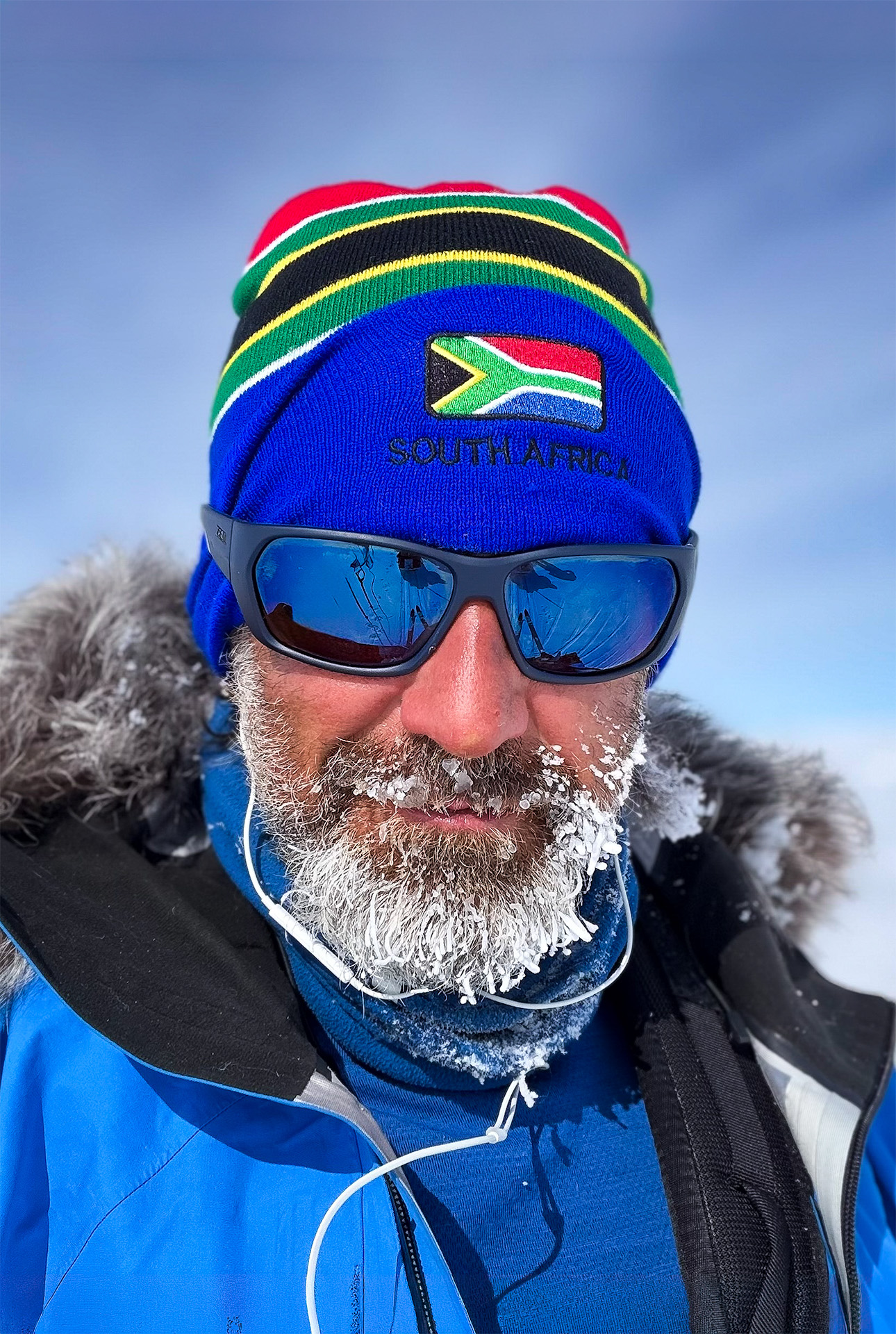
None of this is theory to me. I have watched it hold and watched it break in the one place that does not let you fake it.
On Greenland, two of these carried me. Gratitude and resilience. And they are the two people understand least.
Gratitude out there was not a feeling. It was a job. Some days were so hard that nothing came naturally except the wish to be somewhere else. So you stop. You stand in the wind and you deliberately go looking for something to be grateful for. The light. A working stove. The fact that your feet still move. You do not wait for it to arrive. You hunt for it, because without it the day eats you. That is when I understood gratitude is a skill, not a mood. You can build it on purpose, in the worst conditions, and it changes everything downstream.
And resilience. People think resilience is some inner fire. Out there it was simpler and harder than that. The exit door is closed. There is no car. No hotel. No quitting and going home. You carry on because carrying on is the only thing left. That sounds grim but it taught me something I bring to every client. A lot of resilience is just removing the exit. When there is no way out but through, you find out you can do far more than you thought. Most people never learn that about themselves because in normal life the door is always open. Part of the work is learning to keep going as if it is closed, even when it is not.
Gratitude at the bottom, resilience at the top, and on the days I held both, agency and positivity came back on their own. That is not something I read. It is something the ice taught me, and it is why I keep going back. Everything I teach has to survive out there first.
Is this therapy?
No. Therapy looks back and helps you heal. This looks forward and helps you perform. If you are dealing with real trauma, see a therapist, and I will tell you that on the call. This is for people who are functioning and want to be sharper, steadier, better. Different job.
What if I am not an executive or an athlete?
Then you are most of the people I work with. The labels do not matter. A parent holding it together, someone good at their job who knows there is another level, someone carrying anxiety who wants to be steadier. The one thing that matters is that you are ready to do the work.
How is this different from every other coach?
Most coaching is theory from a book or a lane. Career only. Or mindset only. I see the whole life, and I have tested this where it is not allowed to be fake. On the ice, in the cold, with real consequences. If a framework does not survive out there, it does not make it into the work.
What actually happens on a discovery call?
Thirty minutes. You tell me what you are working on. I tell you honestly whether and how I can help, and if I am not the right person I say so and point you somewhere better. It is just a conversation, not a coaching session.
Do I have to buy a package?
No. The call comes first, always. If we both decide it is a fit, then we talk about what shape the work takes. Nobody gets pushed into a package to find out if we can work together.
Does the polar stuff actually matter, or is it branding?
It matters. The expeditions are where I go to find out if what I teach is true. Greenland was not a marketing trip. It was 553km and 29 days of testing whether resilience, agency, gratitude, all of it, holds when there is no way out. What survives out there is what I bring back to you.
How fast will I see something change?
Some things move in the first few weeks, usually clarity, seeing what is actually going on instead of the story you have been telling yourself. The deeper changes take longer because they are real. Anyone promising you a transformation in seven days is selling you something.
What do you expect from me?
That you show up and do the work. I am not here to agree with you or hand you motivation. I will push, and you have to be willing to be pushed. If you want someone to tell you that you are fine as you are, that is not me.
This is not for everyone. If you want someone to agree with you, or a quick fix you do not have to work at, we will both be wasting our time. It is for people who have decided they are ready, and who want the truth more than they want comfort.
Start With a Conversation.
30 minutes. No obligation. You tell me what you are working on. I tell you honestly whether and how I can help.
Doing this work as a man, alongside other men? See Basecamp for Men.